
Are North Carolina Arrest Records Public?
Mostly, yes, though it depends on the record and who holds it. North Carolina's Public Records Act defines its scope broadly. G.S. 132-1 covers material made or received in public business. Paper files count. Photographs and electronic data count too. A booking photo can fit that definition. Nothing in the statute orders a sheriff to post the image online. No law forces a jail to keep it forever. A court seal, a juvenile rule, an expunction order, or another legal limit can still restrict access. The G.S. 132-1 public-record definition includes photographs and electronic records, which is why an image can be public in custody yet appear in no gallery.
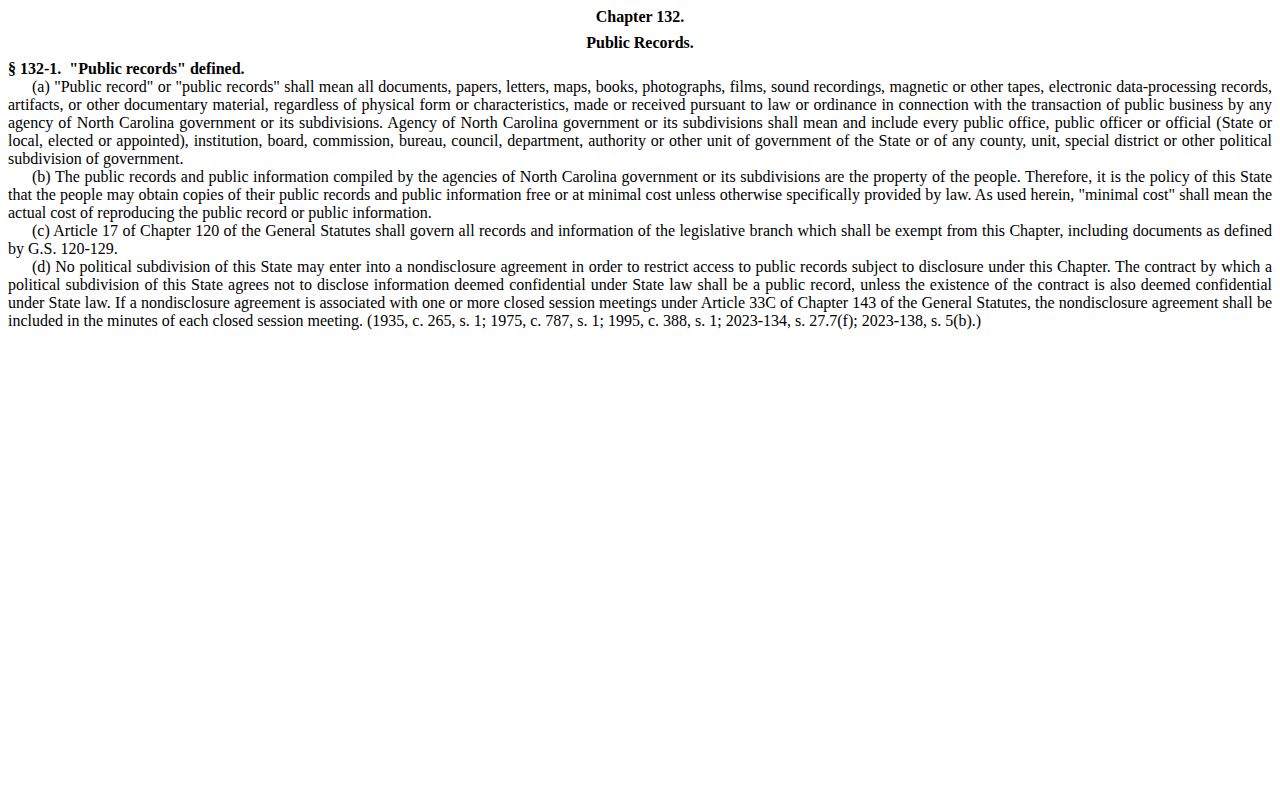
Read the definition together with the exceptions and the more specific arrest-information rule. Public-record status does not mean every web listing is complete or current.
Which North Carolina Arrest Details Are Public?
G.S. 132-1.4 spells out which arrest details are public. It covers the person arrested, charged, or indicted. The public list includes the time, date, location, and nature of the violation. It also includes the person's name, sex, age, address, and alleged violation. Arrest circumstances are public as well. That means the time and place of the arrest, any resistance, any weapon use, any pursuit, and what property was seized. Returned arrest and search warrants are public unless sealed. So are indictments, criminal summonses, and nontestimonial identification orders. The list is not a display mandate. One county portal may publish a dated arrest log. Another may show only a current custody card. A written request may be needed for a copy held in a different system. Agencies can redact material protected by law or report that they hold no such arrest record. Treat any search result as one layer of the booking record, not the full history of a case.
| Record detail | What the law or source can show |
|---|---|
| Violation | Time, date, location, and nature of the alleged violation. |
| Arrested person | Name, sex, age, address, and alleged violation, subject to applicable limits. |
| Arrest circumstances | Time and place, resistance, weapons, pursuit, and property seized. |
| Case instruments | Returned warrants and listed charging instruments, unless sealed. |
The G.S. 132-1.4 arrest-information rule draws a disclosure boundary. It does not direct agencies to publish every part of an investigation.
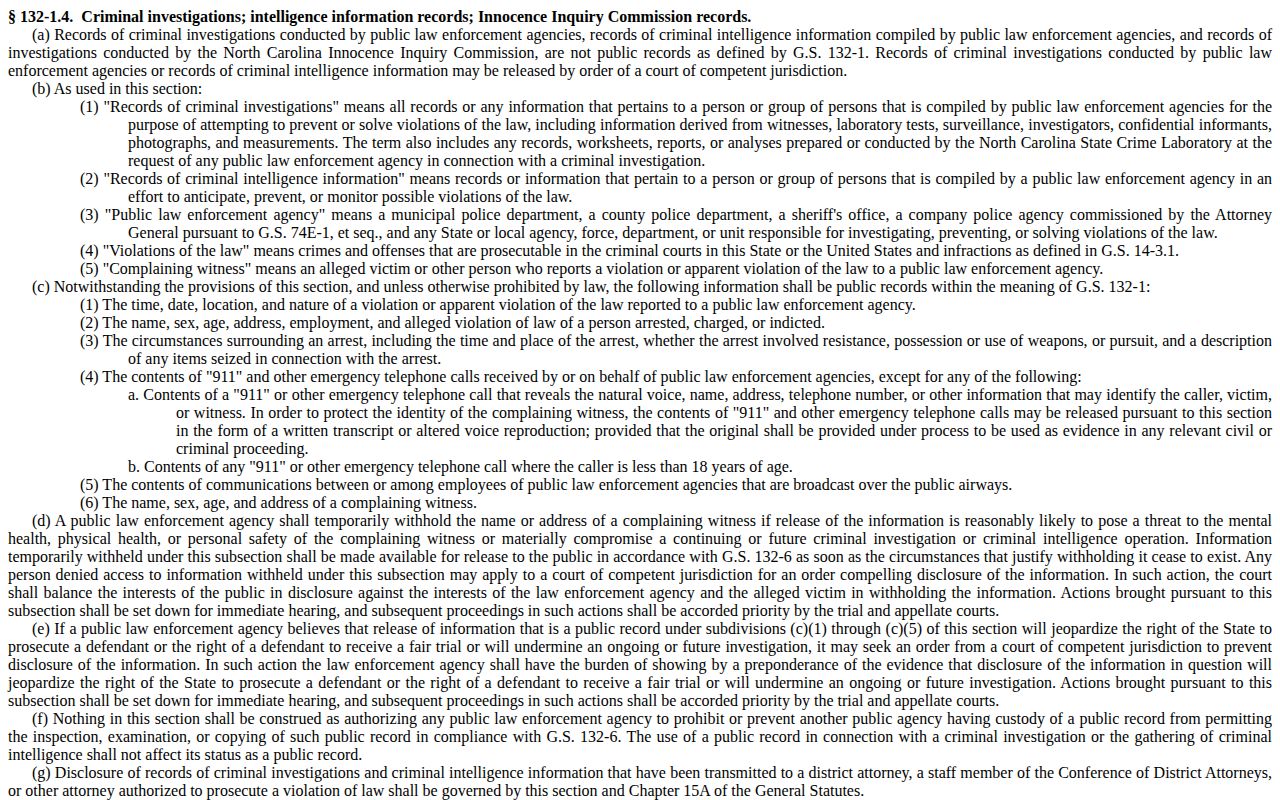
A portal's search window is one thing. An agency's legal duty to disclose is another. North Carolina law treats those as separate questions. So an arrest entry you cannot find online may still exist as a public record the agency must release on request.
Why North Carolina Booking Photos Differ
G.S. 15A-502 governs identification steps after an arrest. It applies to felony and misdemeanor arrests or commitments in the circumstances the statute sets. Photographing is one step. Fingerprinting is another. The statute also covers sending identification material to the State Bureau of Investigation. The FBI can receive it too. Certain motor-vehicle misdemeanors are excepted. All of this concerns creating an official identification record. It does not require a county to post an arrest photograph online. It directs no commercial publisher to receive one. So North Carolina has no single statewide rule turning every booking image into a permanent public web record. One county may show an official photo for a current booking. Another may show text only. A portal's display can shift when its vendor or policy changes, and an image that once appeared online can vanish when the listing rolls off. The G.S. 15A-502 identification statute covers the authority to make and share these photographs and fingerprints.
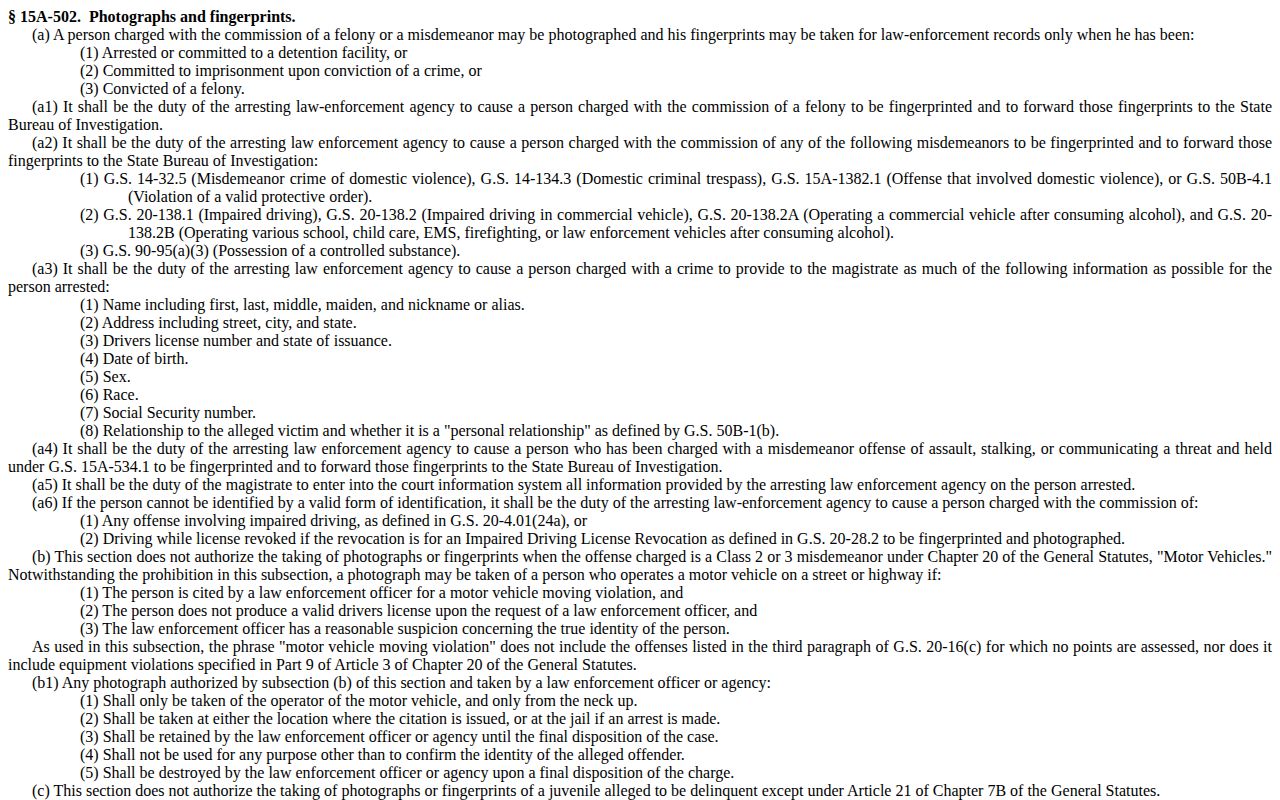
Ask the agency that holds a booking photo when the image matters to a request.
Authority to take the photo is no promise of online display.
What North Carolina Mugshot Proposals Would Change
North Carolina has no enacted statute barring agencies from handing booking photos to pay-to-publish businesses. There is no statewide paid-removal rule either. That gap confuses people. Bills get introduced, debated, even passed by one chamber, yet a proposal never becomes law on its own. Until the official history shows enactment, treat any mugshot-removal claim as a proposal, not a right or deadline.
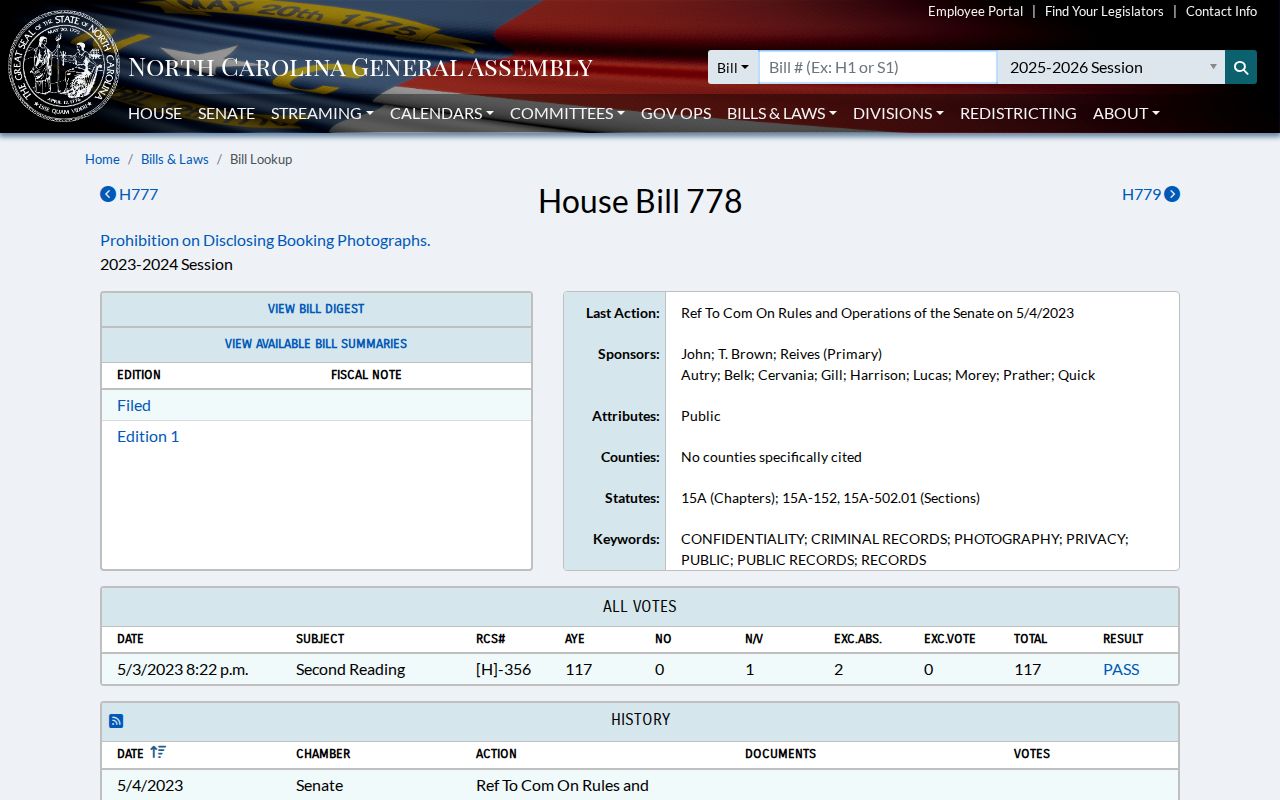
H.B. 778, filed in 2023, is the clearest example. It proposed creating G.S. 15A-502.01, which would have restricted an agency's knowing transfer of a pretrial booking photo to a business that publishes for payment, while leaving agency websites alone. Removal within seven business days would have followed a dismissal, acquittal, expunction, or no-true-bill result, with civil damages of at least $100 per day plus attorney fees. The House passed it. Then Senate Rules, Operations, and Finance received the bill in May 2023, and nothing more happened. The official H.B. 778 bill history traces that path. It documents a proposal, not a current statute.
Two more proposals arrived in 2025. H.B. 446 aimed at disclosure to pay-to-publish businesses and gave sites seven days to remove a booking photo after a documented dismissal, acquittal, expunction, or no true bill. It went to Rules, Calendar, and Operations on March 20, 2025. S.B. 129 took a harder line. It would have made booking photos confidential. Exceptions covered missing-person work and limited law-enforcement or court-order access. Senate rules received that bill on February 24, 2025. Neither became law. The H.B. 446 bill page and the S.B. 129 bill page carry the official histories. Older proposals like 2013 S.B. 744 died the same way, which explains why web pages promise removal rights that no statute grants.
No North Carolina lawsuit has tested a dedicated anti-pay-to-remove statute, because none exists to invoke. A person may still hold a remedy through an expunction order, a seal, a correction policy, or another law. Those questions turn on facts. Legal advice may be needed. Note: Bill histories show what lawmakers proposed, not a change to current law before enactment.
Requesting North Carolina Arrest Records
When a county page lacks the item, ask the agency that made or received the record. G.S. 132-6 guarantees prompt inspection at lawful cost. Exceptions apply. The statute does not order a new statewide compilation. A clear request helps the custodian locate the right system, so for an arrest entry or booking image, use this sequence:
- Name the public agency or county detention custodian that likely holds the record.
- Identify the person or incident, the date range, and the record type, such as the booking entry, arrest sheet, or photograph.
- Ask for inspection or a copy in the format the agency maintains, and ask whether lawful copy costs apply.
- Review any redaction or no-record response, then ask the custodian which office holds a related record if the request reached the wrong layer.
Local routes start with the North Carolina County Directory. The statewide arrest and photo landscape compares county feeds against court records. For state custody or supervision, NCDAC's criminal offender search covers prisoners, probationers, and parolees. It is not the county-jail booking page. A Highway Patrol release may document an event. But the receiving county or regional custodian holds the booking record. A missing web result proves nothing. The arrest record may be delayed, restricted, held elsewhere, or outside the portal's search period.
North Carolina Arrest Records and Juvenile Privacy
Juvenile records skip the normal adult booking path. North Carolina draws that line by statute. G.S. 7B-3001 keeps juvenile law-enforcement records apart from adult files. The public has no inspection right unless a matter is transferred to superior court. Without a court order, access is narrow. Only the juvenile, counsel, a parent or guardian, the prosecutor, the juvenile court counselor, and specified sworn officers may see them. A public adult roster is no shortcut for naming a minor. A photo that resembles an adult booking card settles nothing about age or record status.
G.S. 7B-2102 covers juvenile fingerprints and photographs in covered delinquency cases. Those items never become public under Chapter 132. Destruction follows certain outcomes. No petition can trigger it in the listed circumstances. The same goes for no probable cause, or no delinquency adjudication. Juvenile expunction forms do not authorize publishing a protected record. When juvenile status is unclear, contact the proper custodian or court. The juvenile-record confidentiality rule stands separate from the general public-record definition.
Expunction and North Carolina Arrest Records
Expunction lets a North Carolina court clear an arrest or charge from state records. It can remove or destroy what the state holds. But nothing happens by default. Eligibility turns on the offense, the outcome, the person's age, and any waiting period. North Carolina Judicial Branch materials explain the process in plain language. A win in court and an expunction differ. One does not wipe every copy. G.S. 15A-146 covers many dismissals, not-guilty results, and not-responsible findings. Cases with all charges disposed on or after December 1, 2021 get an automatic route. The statute sets 180 to 210 days after disposition. A felony dismissal under a plea agreement is excluded. An arresting agency may still keep an investigative record tied to the charge.
Other paths sit in G.S. 145.5 for qualifying nonviolent misdemeanors and felonies. One qualifying misdemeanor waits three years; multiple qualifying misdemeanors wait seven. Eligible felony groups wait longer. Serious violent and other listed offenses are excluded. The General Assembly changed parts of the framework in 2025 through Session Law 2025-25 and Session Law 2025-71. The current statute and session laws control. The North Carolina Courts' expunction overview explains the court process and links to its forms.
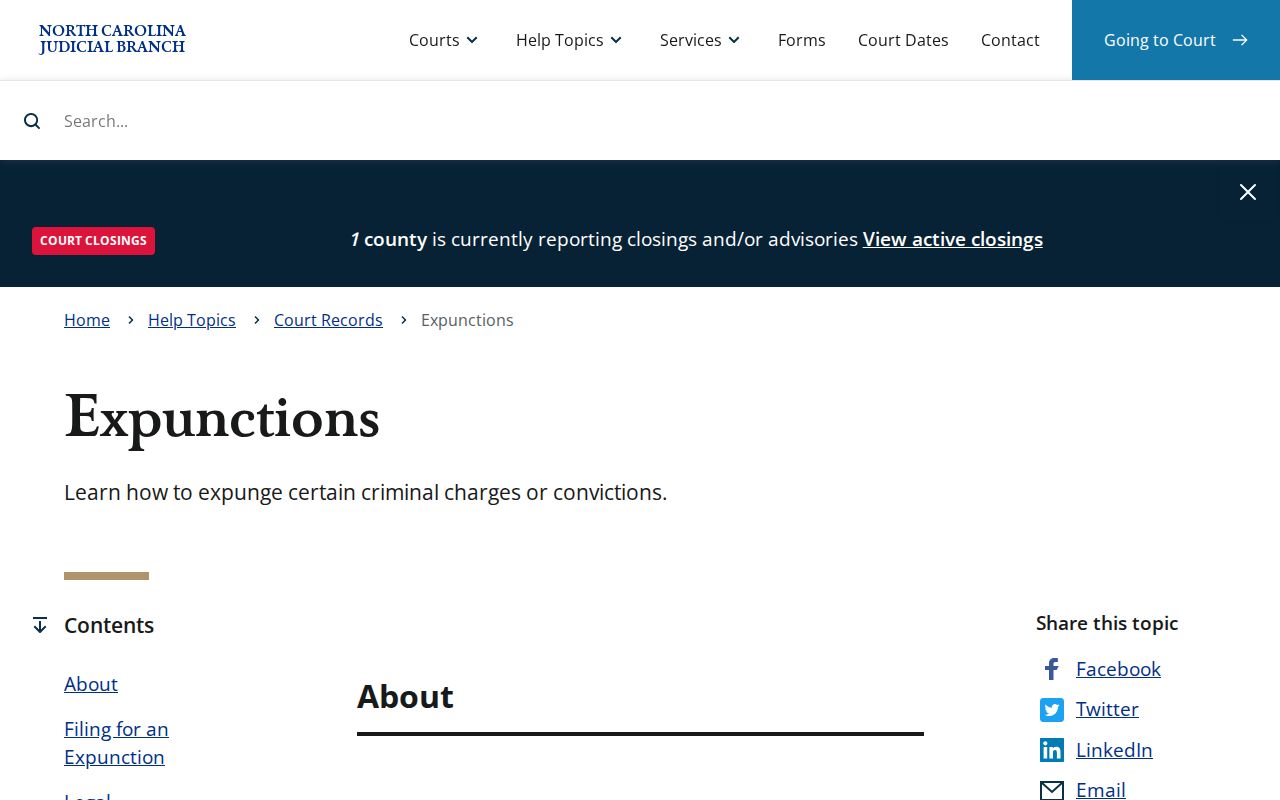
An expunction changes the official record, not every copy beyond it. Outside copies may lag. The official custodian may need notice. A publisher may need a separate request. Note: Eligibility depends on the current statute and case history; a broad summary cannot decide whether an order is available.
When Expunction Reaches North Carolina Web Copies
G.S. 15A-150 makes the clerk send a certified expunction order to the agencies named by law. State agencies with bulk licensing agreements must tell private data recipients to delete the record. The automatic-expunction subsection carries its own notice language. So an automatic result may miss some copies. G.S. 15A-152 reaches a narrower group. It covers private entities paid to compile and share criminal-history data and licensed for state database access. After proper notice, destruction must follow. The deadline is the statute's stated period. Ten business days apply when none exists. It is not a universal deletion rule for every website.
G.S. 15A-153 spells out the effect. It clears the public record and limits disclosure. In practice, the court, the original agency, the portal vendor, a publisher, and a search engine may each play a part. A court order can change the official record while an old cached page lingers. The official record may also stay in a restricted investigative file. A public listing should not appear, though. The G.S. 15A-150 notice framework shows how an order moves to named agencies.
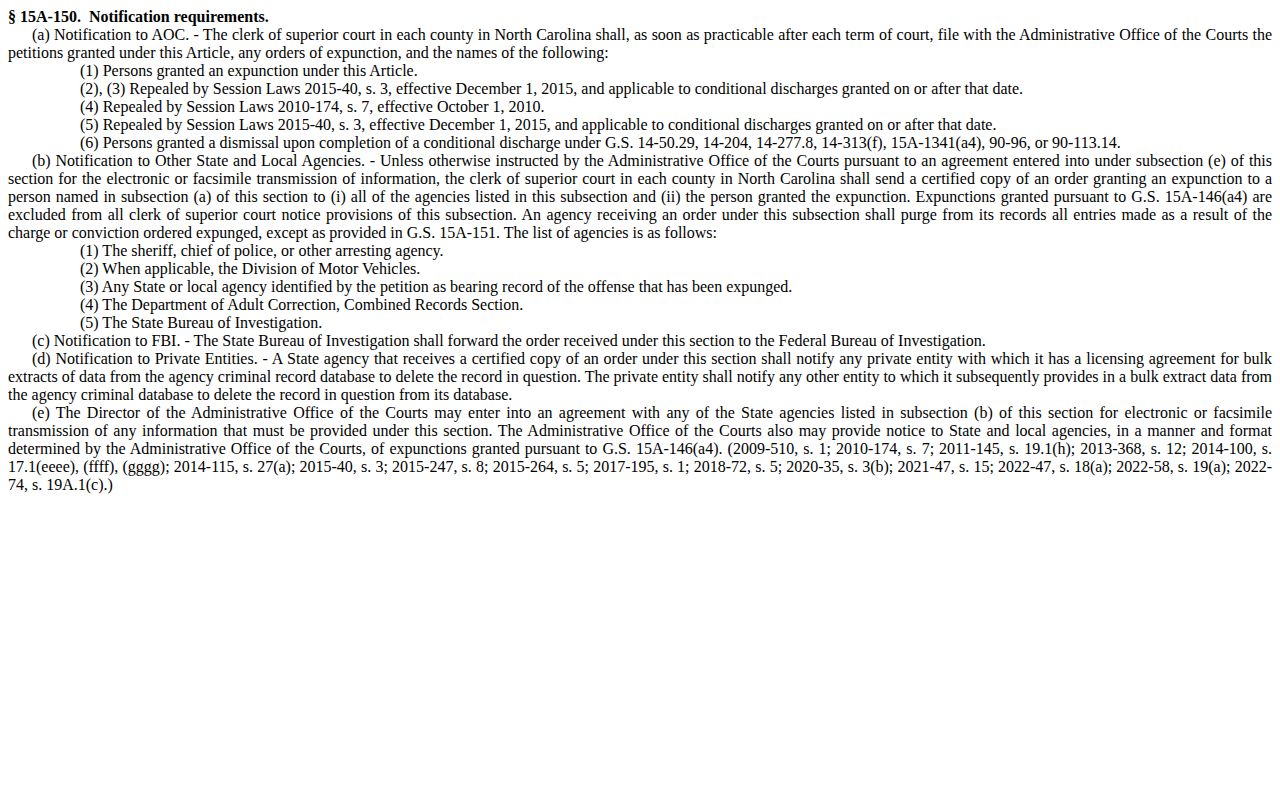
Start with the original custodian. Ask that office to confirm its record was updated. Then use a publisher's free correction route for an independent copy. Busted Newspaper asks for a listing URL and legal proof. Its stated target is five to ten days, with no guaranteed outcome. RecentlyBooked's policy says qualifying corrections and removals are free. Free is not a promise. Do not pay a third party claiming it can erase every source. A stale search result may need a refresh after the source page changes. Its disappearance never changes the court's record. The Busted Newspaper listing-correction page spells out its free documentation path.
| Record layer | Practical next step |
|---|---|
| Court order | Keep the signed or certified disposition or expunction document. |
| Government custodian | Ask whether the official record and public portal were updated. |
| Independent publisher | Use its own free, documented correction process with legal proof. |
| Search result | Request a refresh only after the linked source page has changed. |